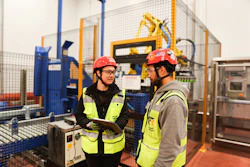
igus' manufacturing facility in East Providence, Rhode Island.
igus
As manufacturers evaluate new AI investments, they keep asking the same question.
“Where has this technology actually delivered ROI?”
As part of a new multi-part series on real-world AI adoption, Manufacturing.net posed this question to six manufacturing and technology leaders. Their responses revealed that the most significant gains come from practical applications that eliminate repetitive tasks, accelerate workflows and help employees focus on higher-value work.
The solutions range from streamlining procurement processes and routing customer inquiries to helping technicians access information faster, accelerating ERP deployments and reducing the burden of administrative work.
6 examples of AI use cases that have generated measurable value
Responses have been edited for length and clarity.
We are using generative AI tools to download publicly available manuals for all the equipment we service. When a new technician comes to work or goes to a new site for the first time, they spend at least an hour, or sometimes two, reading through the SOP in their manual. All a technician needs to do is find the number of the machine they are servicing, and the app automatically pulls up a step-by-step process. It literally turns one to two hours of time into less than five minutes. This is still in beta, but we have piloted with about 10 customers and we've seen 60 more sign up.
We use AI with our CRM system to review every incoming email from customers and to automatically sort those ‘cases’ into various different categories for much faster processing. It used to be one giant bulk case bucket in which 30-plus people would sort through manually and find the right sequence and priorities. We get thousands of emails from customers per day, so having AI pre-sort between new orders, quote requests, order status updates, invoice copy requests, technical inquiries and many other items saves us hours and hours every week. We then automatically route these emails to specific processing teams or automatically answer if they’re generic requests, but we do this very seldom as complex cases are not well handled by auto replies yet. This investment paid for itself in a very short period of time.
You want standardized workflows and you want end-to-end workflows. One of our agents is a procurement agent, and it automates the order-to-receipt workflow. The problem is [people] spend about three to four hours a day for hundreds if not thousands of line items a year doing a set of repetitive tasks to make sure their order arrives on time. An agent is able to complete those tasks for you by connecting into your ERP and inbox, freeing up 80% to 90% of that time. It goes from managing every PO line to doing all the work in the background and then managing by exceptions.
Arturo Buzzalino, SVP of Product and Chief Innovation Officer, Epicor
One of the clearest examples is using AI to accelerate implementation and customization inside ERP. Traditionally, ERP deployments could take 12 to 18 months, because every business has unique needs that require specialist coders. With AI‑driven tools like Epicor’s Prism, manufacturers can move from natural language to customized ERP functions in a fraction of that time. Implementations can now be completed in a few weeks or months. Just as importantly, customers gain the freedom to iterate faster, they can experiment more and can continuously adapt their systems as the business changes.
I have seen good use cases for AI programming and feature-based machining. These kinds of features have been around long before the AI craze, but there seems to be a lot more investment and development going on across CAM platforms/add-ins at the moment. I do not feel we have seen this area fully mature yet, but the results have been promising—mostly towards complicated 3-axis milling and 3+2 milling scenarios. An experienced, qualified CAM programmer still needs to be in the loop, it just saves them time from the busywork of programming.
Jacob Sanchez, Industry Solutions and Community Development, igus
I created a project manager and a task distributor agent. Every new sales opportunity that comes in, I feed it to the task agent. They then distribute to my project agents based on action; if it's education related, speech related, etc. They give me reminders and to-dos, and the project agent checks for timelines or sets them. Something that would get a little lost due to my busy schedule or would take hours from my day every day now takes 15 minutes or so and happens automatically, which is insanely valuable for connecting with my team and community.
If you would like to share how AI has impacted your business, contact Nolan Beilstein at [email protected]